Pages

Showing posts with label Pollution. Show all posts

Friday, May 7, 2010

Soil Pollution

Soil PollutionSoil is one of the basic and important resource provided by nature to us(human being). It is the base of every kind of development and origination. As every one knows that the first creature has originated from the soil. Not only from the history but also from the study about the fossils have provided us with the fact that soils important role through out any kind of development, whether it may development of unicellular animals to multicultural animals or it may be the development of human civilization from caveman age to the modern human civilization. We know it preety well that we human being need food to live and the major portion of the food materials that we consume or obtain are from soil(that grow in the soil). As the human civilization have developed the trend of farming of crops have started instead of hunting. Thus we can say how important role did the soil played in the existence of human civilization.

Soil PollutionSoil pollution mean depletion of soil with different kinds of pollutants mixed with the soil. Soil pollution is of the great concern as it is directly related to the sustenance of thousands of life forms and particularly health of the human and their agriculture activities.
The pH values at different sites showed the great variation of soil and its quality. The pH value in the dumping is about 7.98 showing the soil of the area is moderately basic in nature. The pH values at other sites are below 7 showing that the soils in these localities are neutral to moderately acidic. The value of pH in the soil can be the good indicator of soil pollution with heavy metals. Lower the pH value, more the metals are able to dissolve in the soil. Thus, the pH value of the soil must be maintained above 6.5 to ensure that the soil is not polluted with metal ions. When the pH value is between 4 and 5, the metals like iron, manganese etc. are easily soluble in the soil; thereby plants become more toxic as they absorb these ion.
The temperatures of the soils of the different study area are affecting the development the different kinds of vegetation. The temperature difference affects the activities of microbial activities differently. As we know some plant grows at cold temperature where as some grows in high temperature. In the same manner the activities of the microbes also differs as the difference in the temperature difference in the soil temperature as the microbes of soil requires moderate temperature for smooth functioning(Microbes of soil cannot work effectively in very high "54 degree C" and cannot work at low temperature"5 degree C").As the soil pollution increase the soil temperature also increases.
The nitrogen availability in the soil is also governed by the soil temperature. Conductivity is highest in dumping site (570µs/cm) and lowest in agricultural land(181µs/cm). Condictivity of barren land is 201µs/cm and that of the forest land is 169µs/cm. Thus conductivity is quite high in dumping site whicch is due to the dominance of ions in the site.
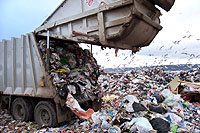
Soil PollutionSoil moisture is an essential element for the physical, biological and chemical activities in the soil as well as the agent for photosynthesis and availability of nutrients. The soil moisture in the study area content to lie between 19.6% and 26.78%. The moisture content in the soil indicates the composition of the soil; although it may be affected by many other factors. Moisture is high agricultural land(19.6%).

Saturday, May 1, 2010

Solid Waste management

Waste is unwanted material left over after the completion of a process. Waste may be in the form of solid, liquid, or even gas. When released into air it causes air pollution, when released into water it forms water pollution and when released into land then it forms soil/land pollution. If any individual produce pollution in the form of gar or liquid then it is called emission and when released in the form of solid then the concept of solid waste arises.

Solid waste management is literally the process of managing of solid waste. It involves the collection, transport, processing and disposal of waste materials. Historically, the aim of waste management has been to prevent or reduce the impact of waste on human health or local amenity.

Waste management practices are often very difficult between urban and rural areas, and residential and industrial/commercial procedures, even within the same local region. Waste management for non-hazardous commercial and industrial wastes is usually the responsibility of the generator. The management and composition of waste materials are quite difficult in developed nations, for a number of reasons.

Solid waste management is one of the major environmental problems faced by all the urban areas of Nepal. The rapid growth of population, urbanization and industrialization has significantly changed the volume and types of waste generated. The uncontrolled handling system of solid wastes in public places such as roadsides, river banks, lake-shores, wetlands etc. has resulted in the solid waste as distinct urban environmental problem.

River Pollution

As human population grows, interactions with water resources on which we are completely dependent, because more and more critical. As population rapidly soars, there is an increasing concurrent prevalence of environmental issues and problems. This is especially true in developing countries where there is less public awareness about environmental problems and an economic need to maximize the use of resources. Water pollution of surface and ground waters is largely a problem in the wake of rising population, rapid urbanization and industrialization. The large scale urban growth of new increased domestic waters while the industrial development manifested either in the growth of new industries or in the expansion of the existing established industries had augmented industrial wastes, the discharges of which into water bodes have brought in hazard of water pollution. Rivers, streams, ponds and lakes receives the heavy load of sewage, industrial effluents and agricultural runoffs. Rivers especially in urban areas are serving as the disposal medium of all kinds of wastes. This condition is very severe in case of the rivers, especially in the rapidly urbanizing cites like those in Kathmandu Valley.

A river may be considered to be polluted when the water in it is altered in composition or condition directly or indirectly because of the activities of man, so that it is less suitable for all or any of the purpose. The main cause of the river pollution in Kathmandu valley is the discharge of excessive untreated sewage into a small river and dumping of solid waste into a small river and dumping of solid waste into the river water and on the riverbank. Such untreated sewage and industrial effluents are the most visible causes of contamination along the urban section of river basins in Kathmandu Valley. The important adverse effects of such river water are loss of aesthetic, recreational and industrial and domestic value of water, spread of water borne disease,
scarcity of safe and clean drinking water, loss of aquatic biodiversity etc.

The water pollution problems in rivers are so serious that the capacity to sustain the aquatic life has already approached to nil at the urban part of Kathmandu. Domestic raw sewage is posing many serious problems than the industrial waste; the concentrations of much toxic sustenance that are originated from which are well within the acceptable limits.

Thursday, April 29, 2010

ACID RAIN

ACID RAINThe precipitation of acidic material in the atmosphere in the form of rain is known as Acid rain. It is caused due to increase in hydrogen ion in atmosphere. Usually rain is very much useful for the organism (plant, animal) and environment. But when the content of acid is found to occur more in the atmosphere then the rain will be harmful. Acid rain is harmful for plant, animals, marine organisms, along with different kinds of infrastructures through the wet deposition. In any surrounding or environment when there is excess emission of compound containing ammonia, carbon, sulfur and nitrogen the danger of mixing of these compounds with water increases resulting into the creation / production of acid rain. Since 1970s Different measures have been undertaken by different government of different countries for the reduction of production of these compounds mentioned above into the Earth’s atmosphere.

ACID RAINAs the industrial revolution began to spread the development of new technology, new way of treatment, new type of vehicle are being constructed or made. But this trend of development has also resulted into the emission of more and more amount of emission of the above mention compounds. For the first time acid rain was discovered during 1852, but detailed studies about the acid rain has begun during 1960s. Robert Agnus Smith was the first individual who had first time described about the acid rain and its effect on its surrounding environment. The effect of acid rain is seen more seen in Europe, China, USA etc where sulfur containing coal have been continuously being burned up to generate heat and electricity.

ACID RAINAcid rain is the result of the industrial revolution but is affecting the living and non living things in different ways. For example many of he aquatic animals are dying due to the effect of the acidic rain water. Not only the aquatic animals but also the forest are also been affected by the acid rain . An example for the effect on the vegetation due to the acid rain is the rain forest or Jizera Mountains, Czech Republic. The effect of acid rain is seen more on different kinds of plants but the effect of acid rain can be reduced on the food crops by the use of lime and different kinds of fertilizers to maintain the level of loss of nutrition from soil.

ACID RAINAs every individual knows clearly that when acid reacts with limestone then limestone will slowly get reduced . Not only the limestone but also in different types of rocks the effect of acid rain is seen clearly. When the acid rain begins then the outer surface of the house will suffer heavily due to the effect of acid rain. Not only the effect of acid rain is seen in buildings but its effect is also seen in the different kinds of statues, stone tablets, stone sculpture. To know it properly we can also see the following equation
CaCO3 (s) + H2SO4 (aq) =CaSO4 (aq) + CO2 (g) + H2O (l)
Here it is shown that when sulfuric acid reacts with the compound containing calcium then calcium sulfate carbon dioxide and water is formed.


ACID RAIN

As we know the symbol of love is the Taj Mahal constructed by the Great Khan king of Mugal emperor known as Shah Jahan in the memory of his beloved wife. But due to the danger of acid rain there has been more concern of people towards the damaging of the outer surface by the acid rain. Not only taj mahal but also on different types of wonder the danger of acid rain have increased.


Sunday, April 18, 2010

Bagmati and it's surrounding

Bagmati and it's surrounding
Bagmati is one of the important river’s of Nepal which flows through the Kathmandu valley by separating Kathmandu and Lalitpur. In hindu as well as Buddhist religion it has a very important place. One of the most important religious temple of hindus(pashupati nath temple) along with other hindu temples (Gokarna temple, Dachhinkali temple) are also located by the bank of this Bagmati river. According to hindu’s tradition all the dead bodies must 3 times be dipped into the bagmati river before cremation begins. Usually the son(first son of the family) who gives fire to the dead body of their parents/relatives must immediately take bath with the holy water from the river bagmati since this river is considered as the symbol of purity in hindu religion.
This river’s main source is at Bagwaar located on the northern hill of Kathmandu Bagmati and it's surroundingvalley.Here three stream join with each other. Mountain stream that passes over the boulder transforms into a larger river. This river flows about 10 km throughout the valley by passing Pashupati nath temple towards the south where is combines with monahara khola and enters the city area by turning west. Here it combines with dhobi khola, Tukucha khola , Vishnumati khola,etc. Leaving the city it passes through the dachhinkali temple, cut through mahabaharat range crosses the sivalik hill, reach terai, and reaches india by passing nepal’s territory..
The pollution of this bagmati river begins from outside the valley by agricultural land, and human and when enters the valley is polluted by untreated household wastages through drainage

To know more about the problem of bagmati river just
click here

Counter for Unique user

Powered by Blogger.